
What the Model Context Protocol is, how it relates to function calling and to agent-to-agent protocols, and where to learn it step by step.
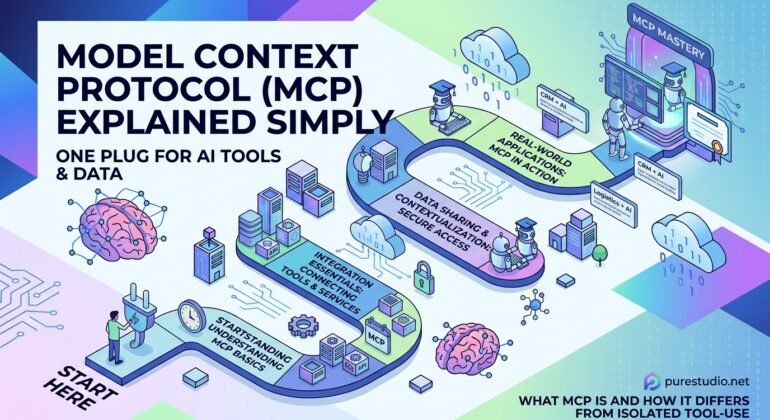
If you have used an AI assistant that can read your calendar, search your files or look up an order in your shop, something had to connect the assistant to those systems. MCP (Model Context Protocol), short for Model Context Protocol, is a common way of doing that connection.
The problem it solves
Before a shared standard, every AI application needed its own custom integration with every service. Ten apps and ten services meant up to a hundred separate pieces of glue code.
MCP was introduced by Anthropic in late 2024 and has been widely adopted since. It splits the job in two. A service writes one MCP Server that describes what it offers. Any application that speaks MCP, such as a desktop assistant, a coding agent or an editor, can then discover and use it. The usual comparison is USB-C: one standard plug instead of a different cable for every device.
What a server actually offers
A server can expose three kinds of thing. Tools are actions the assistant can ask for, such as “find this order” or “create a ticket”. Resources are material it can read, such as a file or a database record. Prompt templates are reusable starting points for common requests. The server runs either on your own machine or remotely over the web, and it can come from a vendor, from the community or from you.
How it relates to function calling
Tool Use / Function Calling is the underlying mechanism: you describe a function to the model, the model answers with a structured request to run it, and your own code decides whether to run it and returns the result. The model never executes anything itself.
MCP builds on that idea and standardises the packaging. With plain function calling you wire each tool into each application by hand. With MCP you describe the tools once, inside a server, and they travel to every compatible application.
Where agent-to-agent protocols fit
MCP connects an agent to tools and data. A different protocol, A2A (Agent2Agent Protocol), is about agents talking to other agents, possibly built by other companies. It is younger and less widely adopted. If you are connecting your own systems to assistants, MCP is the one to learn first.
A caution worth knowing
An MCP server often holds credentials and can change things in real systems. Treat a third-party server the way you would treat any software dependency with access to your accounts: check where it comes from, give it the least access it needs, and keep a person approving actions that cannot be undone.
Courses that teach it
Master Claude AI Fable 5, Cowork & Agents for Business is a good first look if you want the idea in plain terms. It has a lesson called “MCP in Plain English” inside a broader tour of connectors, plugins, sub-agents and team rollout.
The Complete Model Context Protocol (MCP) Masterclass is the dedicated option. It runs about five hours and covers the protocol’s architecture, implementation patterns and how to build your own server.
Anthropic Claude Certified Developer Foundations (CCDV-F) Cert Prep treats MCP tools as one topic among many, next to the Messages API, Claude Code and guardrails. It suits someone preparing for that certification rather than someone who only wants MCP.