
How an AI agent differs from a chatbot and from a fixed workflow, what it costs you in predictability, and three courses that teach it.
“Agent” is one of the most overused words in AI, so it helps to pin it down. An AI Agent is a system where a language model works toward a goal by choosing its own steps, calling tools, looking at the results and carrying on until it decides the job is done.
The loop at the centre
Everything an agent does sits inside a loop. The model looks at the goal and what has happened so far, picks an action, the surrounding software runs that action, and the result is fed back to the model. That cycle is the Agent Loop. The actions are usually tools the model asks for through Tool Use / Function Calling, such as searching a document store, reading a file or creating a ticket.
A helpful comparison is the difference between hiring a contractor and handing a worker a checklist. The contractor gets a goal and a toolbox and decides the order. The worker with a checklist follows fixed steps. In software terms the checklist is a workflow, and it is what many useful AI automations really are.
Agent or workflow
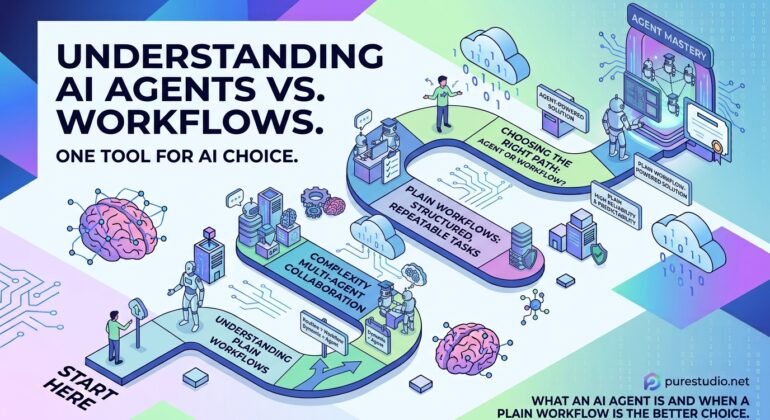
A workflow runs the same steps in the same order every time, even if one or two of those steps call a language model. An Workflow vs Agent sits in between: the broad shape is fixed, but the model makes choices at certain points. A full agent chooses the path as it goes.
That freedom is what makes agents good at messy tasks, such as researching a topic or tracking down a bug. It is also what makes them harder to predict, test and budget. A workflow that fails fails at a known step. An agent can wander, repeat itself or spend far more than you expected.
A sensible rule is to use a plain workflow whenever you already know the steps, and to reach for an agent only when the path really does vary from case to case. Whichever you choose, decide in advance where a person must approve something. A Human-in-the-Loop (HITL) checkpoint before an irreversible action costs little and prevents most of the stories people tell about agents going wrong.
Courses that teach it
AI Agents with n8n Build a No-Code Agent in 30 Minutes is the quickest way in. It runs about 35 minutes, explains how a language model differs from an agent, and then assembles one node by node in n8n, testing and fixing it along the way.
Building AI Agents and Agentic Workflows Specialization is for people who write code. It starts with tool calling and chaining, works through LangChain, and then covers LangGraph, including agents that improve their own results.
Production AI Agents Reliable Business Workflows is the one to take before promising anyone an agent. It opens on the gap between a good demo and a dependable system, looks at when a plain automation beats an agent, and covers role definitions with authority limits, structured handoffs, tracing and approval gates.