
What retrieval-augmented generation is, why most RAG problems are search problems, and which courses teach it from the first build to evaluation.
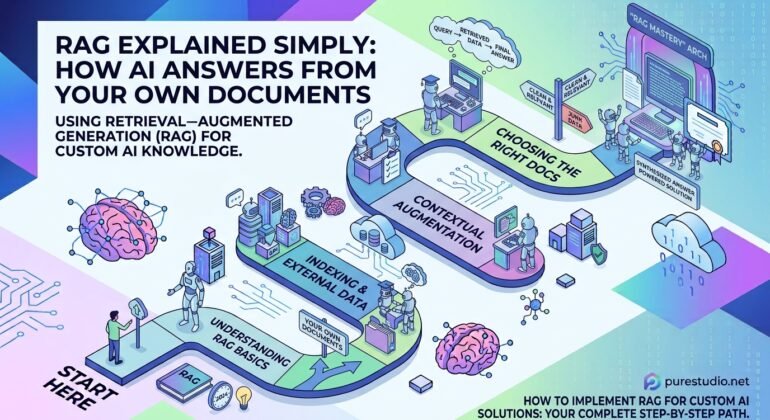
A language model only knows what it saw during training, and it cannot see your product manual, your policies or last week’s support tickets. Retrieval-augmented generation, usually shortened to RAG (Retrieval-Augmented Generation), is the standard way around that. Instead of hoping the model remembers the right thing, you look the answer up at the moment of the question and hand it to the model along with the question.
The open-book exam
The best comparison is an open-book exam. A student who relies on memory may get details wrong. A student who is allowed to look up the right page first and then answer from it is much more reliable. A RAG system does the second thing.
In practice it works in two stages. First the system searches a knowledge source for passages that look relevant to the question. Then it places those passages in the prompt with an instruction to answer from them and, ideally, to say which passage it used. This is what people mean by Grounding: tying the answer to a source you can check.
The model itself is not changed. The knowledge lives in a search index, so you can update a document today and the next answer reflects it. That is the main reason RAG is more common than retraining a model for company knowledge.
Where the quality comes from
Most RAG quality problems turn out to be retrieval problems. If the search brings back the wrong passages, the model has nothing good to work with, however capable it is. Three ideas matter most.
Documents are split into pieces before they are indexed, and the way you split them, called Chunking, decides what the search can find. Each piece is turned into a list of numbers called an Embedding, which lets the system find passages that are close in meaning rather than only matching the same words. Those numbers are stored in a Vector Database, which is built to find the nearest matches quickly.
Because the weak point is usually search, the sensible way to improve a RAG system is to test the retrieval on its own, with real questions, before touching the prompt.
Courses that teach it
The Power of Vector Databases for Absolute Beginners is concept first, with quizzes and recaps. It explains vectors, what a vector database is, how the search workflow runs and how to choose one, and it includes a lesson on RAG itself.
Generative AI and LLMOps Building, Fine-Tuning, and Deploying LLMs places RAG inside the whole life of an application. Its section on grounding covers why models need it, similarity search with embeddings and a working RAG solution, and a later section compares fine-tuning with RAG.
Building RAG Applications with LangChain is the hands-on option. It builds a RAG pipeline in LangChain, moves on to advanced retrieval techniques such as query transformation and corrective RAG, and finishes with measuring retrieval quality and tracing runs.