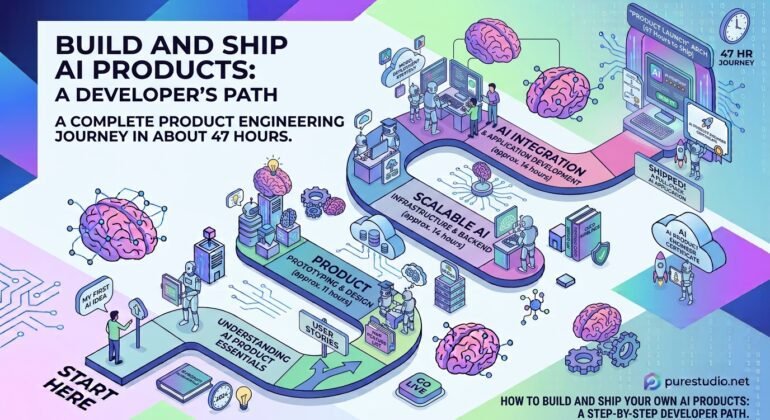

Eleven courses in order, from a first Claude Code project to evaluation, agents, testing and security, for developers who want to ship AI features.
This is the longest of the learning paths, about 47 hours across eleven courses. It is aimed at developers who want to build and ship AI features, and it goes more smoothly if you have already worked through an automation path, because ideas such as MCP and skills carry straight over.
Learn one coding agent properly
Claude Code Made Easy – Beginner’s Guide to AI Coding is a beginner course of about six hours in which every lesson has a hands-on file. It installs across the desktop app, VS Code and the command line, and builds and deploys a real site. Before investing weeks in a workflow, take Strengths and Limitations of Claude Code, about 40 minutes of judgement on when the tool fits and what the risks are. Advanced Claude Code then covers subagents, git worktrees, MCP with GitHub and Figma, and team-scale policy and cost monitoring, and Extending Claude Code with Plugins shows how to package a behaviour so others can reuse it. If the idea of Agentic Coding is new, start there.
Understand the models underneath
OpenAI API Foundations Build Your First AI Application takes about an hour and a quarter and covers the Responses API, tool calling, embeddings and semantic search from first principles. Claude with Amazon Bedrock by Anthropic is Anthropic’s own developer curriculum, and it treats evaluation as a first-class topic, with test datasets and model-based and code-based grading. Evaluation, covered by Evaluation (Evals), is the skill that separates something that works once from something fit to ship.
Data and agents
Vector Databases for Developers ChromaDB, Pinecone & RAG goes from embeddings to a local database, a retrieval chatbot and a migration to a hosted service, which is the right order for RAG (Retrieval-Augmented Generation). Build AI Agents with OpenAI Agents SDK Text & Voice builds a travel assistant with handoffs, guardrails and voice, plus offline evaluation. Production AI Agents Reliable Business Workflows is the reality check: when a plain automation beats an agent, how to define roles and approvals, and how to trace failures.
Quality and security
The path ends with the work that makes software trustworthy. Complete AI-Driven Unit Testing for Developers compares agentic test generation, Diffblue Cover on Java and AI-driven test-first development in Python. Secure Agentic Software Development – Beyond Vibe Coding covers least privilege, sandboxing, reviewing AI-written diffs and supply-chain controls for code written by agents.
Suggested pacing
Take the Claude Code courses first, then pick the API course that matches your stack. Do the data and agent courses when you have a project that needs them, and finish with testing and security before anything reaches users.
Courses mentioned
- Claude Code Made Easy – Beginner’s Guide to AI CodingAI Coding · Beginner
- Strengths and Limitations of Claude CodeAI Coding · Beginner
- Advanced Claude CodeAI Coding · Advanced
- Extending Claude Code with PluginsAI Coding · Beginner
- OpenAI API Foundations Build Your First AI ApplicationAI Coding · Beginner
- Claude with Amazon Bedrock by AnthropicAI Coding · Advanced
- Vector Databases for Developers ChromaDB, Pinecone & RAGData & RAG · Intermediate
- Build AI Agents with OpenAI Agents SDK Text & VoiceAI Agents · Intermediate
- Production AI Agents Reliable Business WorkflowsAI Agents · Intermediate
- Complete AI-Driven Unit Testing for DevelopersAI Coding · Intermediate
- Secure Agentic Software Development – Beyond Vibe CodingVibe Coding · Intermediate
Related terms
- Agentic CodingDelegating programming tasks to an AI agent that reads the codebase, plans, edits files, runs commands and tes
- RAG (Retrieval-Augmented Generation)Looking up relevant information from your own sources at question time and inserting it into the prompt so the
- Evaluation (Evals)Systematically testing an AI system on representative cases and scoring its outputs, so you know how well it w