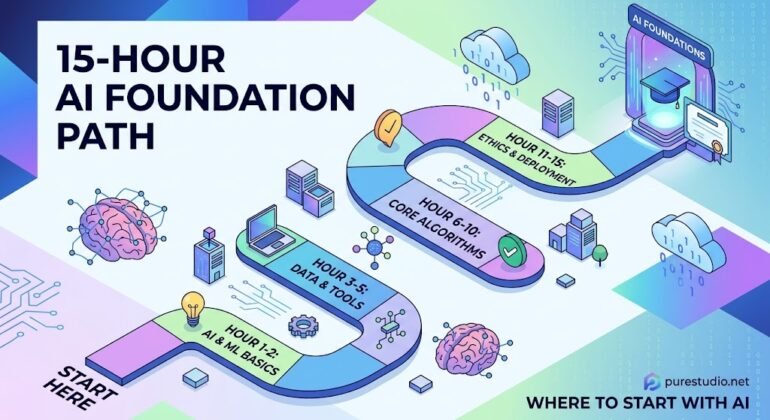

A five-course starting path for anyone new to AI, in a sensible order, with what each step adds and how long it takes.
The library holds well over a thousand courses, and that can make the first choice harder than it should be. If you are new, this five-course path gives you the mental model and the map first. Together the courses take about fifteen hours, and none of them needs any programming.
The idea behind the order
Most beginners jump straight to a tool and then get stuck when the tool behaves oddly. The path below starts with how these systems work, moves on to how to talk to them well, and only then looks at specific products and workplace habits. You can stop after any step and still have something useful.
Step 1: understand what AI is
Intro To Ai Ai Literacy For Everyone takes about three hours. It separates AI, machine learning and deep learning, explains how models learn, and covers embeddings and retrieval. It closes on the uncomfortable parts: hallucination and the cost of running a model. Starting here means nothing later feels like magic.
Step 2: give the model better context
Beyond the Prompt Context Engineering for AI is two hours and has the best return on time in the set. It explains the difference between uploading files, keeping a knowledge base and using retrieval, offers a repeatable framework for prompts, and teaches you to diagnose why an answer went wrong. Many bad answers come from poor context rather than a poor model.
Step 3: see the whole map of one assistant
Claude Mastery From Your First Prompt to Operating System runs about four hours and walks through the range of Claude’s features: Projects, Artifacts, Cowork, scheduled tasks, plugins and Claude Code. Watch it to learn what exists rather than to master every part. It also touches on MCP (Model Context Protocol), the standard that connects assistants to outside tools.
Step 4: learn prompting across vendors
ChatGPT Prompt Engineering Essentials is about four and a half hours, laid out like a textbook with stated learning objectives. It keeps you from being tied to one vendor, and it ends at the API rather than stopping at the chat window.
Step 5: use it well at work
Ai Literacy For Employees Use Gen Ai Well At Work is the shortest, at roughly an hour and a quarter. It covers judging output before trusting it, bias, and not leaking company data, including the habit of using unapproved tools at work. It is cheap insurance, and a good one to finish on.
After the foundation
From here the library branches by goal: automating tasks, building software with agents, preparing for a certification, or advising other businesses. Pick the branch that matches what you want to do, rather than trying to cover everything.